|
|
|
|
|
|
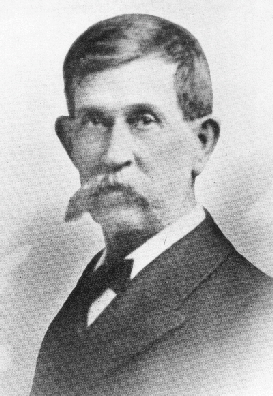
Colonel Thomas M. Jones
Thomas M. Jones Brigade at the Battle of Perryville
|
|
|
|
Thomas Marshall Jones was born on March 11, 1832, in Hampton, Virginia. His parents were John Pembroke Jones and Mary Sclater Booker Jones. He was one of six children. One of his brothers was Captain John Pembroke Jones who was a career naval officer. He served as a coastal surveyor with the United States Navy until the Civil War. He joined the Confederacy and became a lieutenant on the CSS Virginia, also known as the Merrimac, and later commanded the ironclads CSS Georgia and CSS Raleigh. Another brother Captain George Booker Jones was a lieutenant in the Old Dominion Dragoons. The cavalry unit became the 2nd Viriginia Cavalry Company F, later the 3rd Viriginia Cavalry, Company F. He rose to the rank of Captain of Company B, 3rd Virginia Cavalry. In 1864, he was on the staff of Colonel C. H. Simonton.
|
|
|
Thomas Jones was a cadet at the United States Military Academy at West Point, New York from July 1, 1849, to July 1, 1853. When he graduated, he was appointed to second lieutenant and served at the garrison at Fort Columbus, New York, between 1853 to 1854. He was on frontier duty at Ringgold Barracks, Texas in 1854 and Fort Davis, Texas from 1855 to 1859. On July 19, 1858, he was promoted to second lieutenant of the 8th Infantry, and was adjutant of the 8th Infantry from October 10, 1859, to December 13, 1860, at San Antonio and Fort Mason, Texas and as aide-de-camp to Brevet Major General David Twiggs from December 13, 1860, to February 28, 1861. On February 28, 1861, he resigned from the United States army to join the Confederate army. He became Chief of Commissary for Confederate General Braxton Bragg at Pensacola, Florida. On January 14, 1862, he was appointed colonel of the 27th Mississippi Volunteer Infantry. The 27th Mississippi was organized between the months of November and December 1861. The regiment camped at Aberdeen, Mississippi. .
|
|
|
|
|
|
|
After the regiment was mustered into service, the men of the 27th Mississippi were ordered to Mobile, Alabama, where the regiment did guard duty until February 12, 1862, when the regiment was ordered to Pensacola, Florida, to perform picket and guard duty, and to manage some coast batteries between the Warrenton navy yard and old Fort Barrancas. The regiment had a hand in dismounting and shipping all the heavy guns in the batteries at Forts Barrancas and McRee, which were sent to Mobile and Vicksburg. The regiment also shipped all of the heavy machinery out of the navy yard
|
|
|
|
|
|
On October 9, 1861, General Bragg ordered an assault on Fort Pickens that was unsuccessful. Union Colonel Harvey Brown, the commander of Union forces, planned to attack Fort McRee. From November 22, 1861, to November 23, 1861, Fort McRee and the Pensacola Naval Yard were bombarded by Union forces. Fort McRee had huge areas blown out of the walls with one section collapsing from the Union assault. Six Confederate soldiers were killed. When word reached Bragg that New Orleans, Louisiana had been taken by Union forces, in May 1862, the decision was made to abandon the city of Pensacola and Fort McRee. On May 12th, 1862, the 27th Mississippi helped in the final destruction of the navy yard by preparing combustibles and placing one or more large artillery shells in every building. The cavalry had the order to set the combustibles on fire, when the Confederate troops evacuated that night. On May 13, Jones, along with the 27th Mississippi arrived in Mobile. On July 22, 1862, the 27th Mississippi was ordered to Chattanooga, Tennessee to join Bragg’s Army of the Mississippi
.
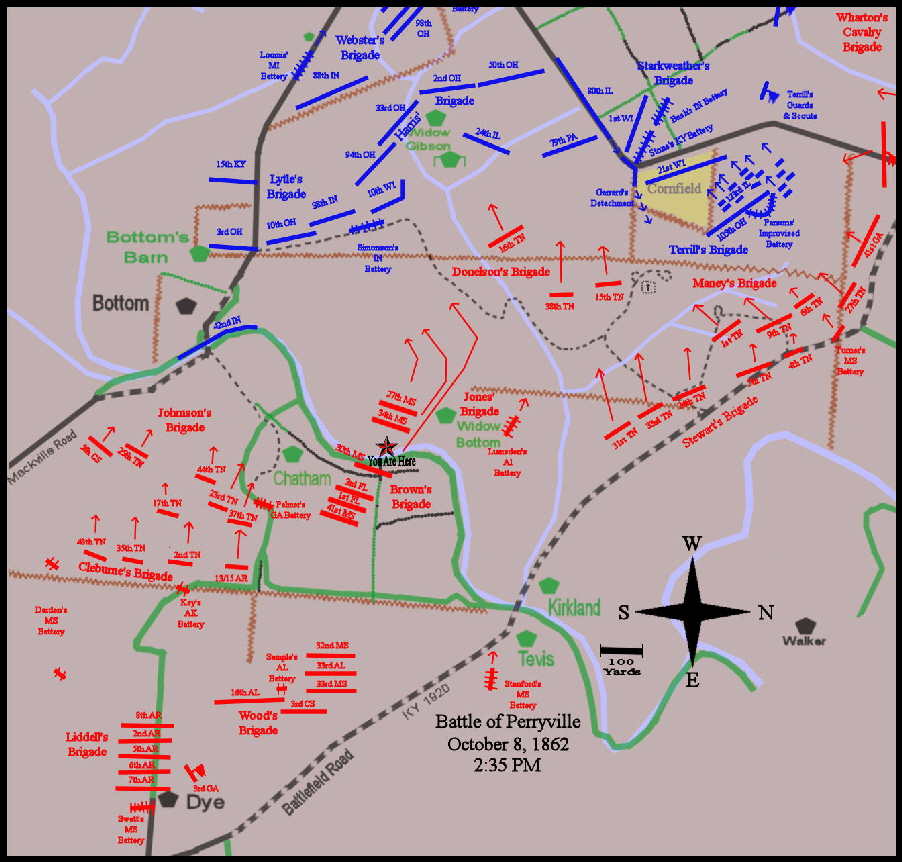
During the Confederate invasion of Kentucky, Bragg appointed Thomas Jones to command a brigade. Jones’s brigade consisted of the 27th Mississippi, commanded by Lieutenant Colonel James L. Autry, the 30th Mississippi, under the command of Colonel George G. F. Neill, the 34th Mississippi, under the command of Colonel Samuel Benton, and Battery F, 2nd Alabama Light Artillery, under Captain Charles Lumsden. Jones’s brigade was under General J. Patton Anderson’s Division, under Major General William Hardee’s Corps.
|
|
|
 |
|
|
|
|
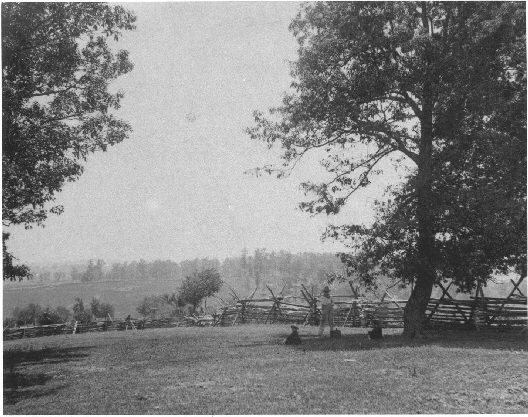
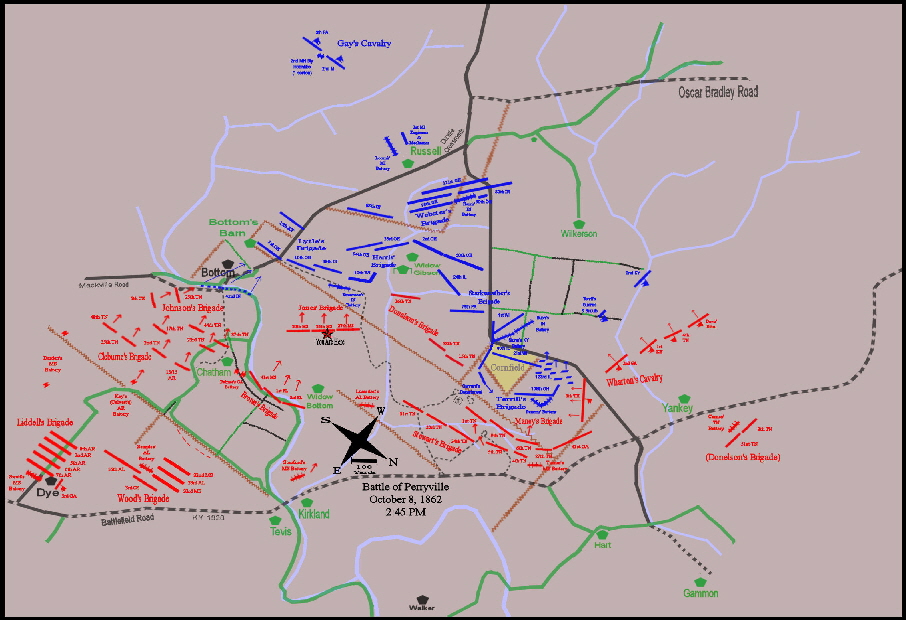
On October 8, 1862, during the battle, Confederate General Braxton Bragg, commander of the Army of the Mississippi, ordered Jones to fill a gap created by Confederate General S.A.M. Wood’s brigade and Confederate General Simon B. Buckner’s division. At 2:30 pm, Thomas Jones’s brigade moved forward against Union Colonel Leonard Harris’s brigade, who were located on high ground and protected by Captain Peter Simonson’s Indiana battery. Jones’s attack was supported by Captain Lumsden’s Alabama battery. Jones’s brigade crossed Doctor’s Creek. Several hundred yards behind Jones was Confederate General John C. Brown’s brigade. Brown was to follow Jones in attacking the Union position. Jones approached Harris’s line. The brigade passed the home and apple orchard of Mary “Polly” Bottom. The brigade descended into a low depression between the two ridges. Jones brigade marched west through the low depression and up the eastern side of the steep ridge to their front. Because of the steep terrain, Jones could not see the Union soldiers and battery. Jones’s men had no idea of the terror and destruction that awaited them on the other side of the ridge.
Company K, of the 27th Mississippi, was the first regiment to top the ridge. The commander privately purchased British Enfield Rifles for the company. The rest of the company was equipped with smoothbore weapons. Jones’s brigade amounted to only nine hundred men. When Company K reached the ridge, they were faced with five thousand Union soldiers under Harris’s and Union General William H. Lytle’s brigades, along with six guns of Simonson’s battery. In between Company K and the Union line was a narrow ridge thirty feet deep with a large sinkhole. Henry Bottom had planted corn in the ravine that summer and cornstalks were still left around the sinkhole. Jones’s brigade would have to advance through the cornstalks, up the ridge, at the top of the ridge was a worm fence that protected the Union soldiers. Captain John Sale, of Company K, stopped and shouted back to Colonel Lt. Colonel A. J. Hays that they had reached the thirty feet high ridge. The colonel yelled “Forward the skirmishers!”
|
|
|
|
The skirmishers of Company K went over the top of the ridge and into the low hollow. The terrain in the low area protected Jones’s brigade. Simonson’s Indiana battery loaded their guns with the shot gun type rounds called canister shot. Once Jones’s men were within range the cannons opened fire. At the same time, the 10th Wisconsin of Harris’s brigade, supporting the battery on the left and the 10th Ohio of Lytle’s brigade to Simonson’s guns on the right fired three volleys into Jones’s men at a range of 150 yards. Jones’s brigade made four attempts to descend into the ravine before the brigade ran out of energy in the blazing hot sun. Jones’s brigade lost fifty men killed, with four hundred wounded. Jones’s brigade had a casualty rate of fifty percent. With such staggering losses, the brigade finally fell back behind the ridges and would not fight for the rest of the battle. Jones’s brigade fighting for the day was over. Brown’s brigade continued the fight after Jones’s men fell back. The Union soldiers were running out of ammunition and due to Jones’s men and Lumsden’s artillery, Simonson’s Indiana battery lost fourteen men and sixteen horses. Major Henry Cotter, General Alexander McCook’s Chief of Artillery, ordered Simonson to pull his battery from the line and fall back three hundred yards towards the John Russell house. Finally, a third Confederate brigade under General S.A.M. Wood was able to break the Union line.
|
|
|
|
|
|
George M. C. Davis, Company D, of the 30th Mississippi Infantry, wrote to his daughter E. L. Boone about his fighting during the battle. He wrote: About 2 p.m. our regiment formed in line of battle on the top of a long high ridge, our cannon was stationed along on top of this hill, The Federals occupied a high hill about one mile in our front and their cannon were stationed along on this hill, and there was a small hill between us and about 300 yards from the Federals, about 2:30 p.m. the artillery on both sides turned loose, we were ordered to lie down, and you can’t imagine how quickly that order was obeyed, ˜ remember this was our first battle, limbs falling all around us, men and horses being torn to pieces & shot and shelled plowing through our ranks made it a little demoralizing ˜ but about 3 p.m. we were ordered forward, we moved out of the timber into an old open field and in plain view of the enemy & they turned their artillery upon our advancing line, & as they cut great gaps in our line we would close up and press forward, we soon got so far down the slope that the intervening hill protected us from their artillery, and we moved on till we came to the top of the little hill, and then the battle began in earnest. Our color bearer had planted our flag at the very top. Their cannon and musketry swept the top with shot and shell, we were ordered to drop back and use the hill as a kind of breast work and only expose ourselves when we arose to shoot.
The deafening roar of the cannon, the bursting of shells, and the rattle of musketry made a Perfect inferno. After we had been thus fighting for perhaps an hour I saw our flag go down, and I ran to it and planted the remaining part of the flag staff firmly in the ground and fired. But while doing so I noticed the dust flying up some fifty yards this side of the enemy line and I stood there for a little while watching, and I saw that our men as a rule were shooting too low. I ran back to the foot of the hill where our colonel and his aids were and told him our men were shooting too low and were not doing much damage. He said: “who ordered you to make these observations?” I hung my head and had to admit that I had done so without orders, “go back (said he) and pass the order down the line to shoot higher, and you keep off the top of that hill unless the flag goes down.” I went and did as I was ordered, feeling a little hurt at the remarks of the colonel” but we soon saw that the enemy was in confusion and their firing was not so regular or deadly for they were shooting wild and reckless; We were then ordered to charge.
|
|
|
|
 |
|
|
|
We raised the rebel yell and went over that hill in double quick; they tried to check our advance by pouring into our ranks shells, grape, canister, and rifle balls. But nothing could withstand that charge and they fled in a panic leaving their cannons and their dead and wounded. We turned their own guns upon them and with their own ammunition continued to throw shot and shell into their retreating ranks until darkness put a stop to the carnage ˜ Even the memory of it, now makes me shudder ˜ but that was war ˜ or hell.”
John Freeman, Company I, 34th Mississippi wrote in his diary about his experience of the battle. He wrote: We was ordered fire and fall down then rise and double quick until a general engagement commenced. We kept advancing till compelled to fall back on account of a heavy cross firing which wounded and killed half of my company, four being associate and bro-in-law J. W. Hargis, and orderly J. C. Cathy, Jas. Simpson and Corp. Oldfield. Two others died from their wounds. I discharged my duty the best I knew how, shot 18 times, then helped Capt. Bowen to carry Levi Childress off the field and continued to help carry off wounded till after night. Our little company was rallied and charged the enemy's Battery under Adjut. Miller, one and the only officer that was not wounded. Col. Benton, Lt. Col. Wright and Major Mason all being wounded. Col. hip, Lt. Col. arm, Major foot.
Robert Jarman, of the 27th Mississippi, wrote an article, in the Aberdeen Examiner newspaper, in 1890, about his experience at the battle of Perryville. He wrote: While upon the advance movement Company K arrived at a precipice fully thirty feet high. Captain Sale halted the company and called back to Colonel Hays that here was a precipice thirty feet high. Colonel Hayes responded, “Forward the skirmishers!” which was done, Sale in the midst. When the regiment reached the place, Captain McLemore,[6] of Company B, slipped over the face of the precipice and said, “Company B follow me!” and he was followed by the entire regiment.” It was here that old John, Captain Sale’s servant, was so badly scared that he ran the old gray horse of Captain Sale back to the wagon train, and when the next day received a scolding for riding so fast, he said that the horse scared and ran away with him. Some of the killed here were George Lagrone, J.A. Grady, Jim White, S.J. Willoughby and I cannot now remember the others. Here Major Lipscomb was killed and at the time he was the only field officer of the regiment from Mississippi.
After the battle of Perryville, Thomas Jones’ last engagement was the Battle of Stone’s River or Murfreesboro, Tennessee. After the battle, he was frequently ill and deemed unfit for command. He took command of Fort Caswell near Wilmington, North Carolina, in 1864, but he resigned due to deteriorating health.
After the Civil War, Jones became a farmer, in Fauquier County, Va., from 1866 to 1874, and 1877 to 1881. From 1874 to 1877, he was professor of agriculture at the Maryland Agricultural College, near Washington, D. C. From 1881 to 1885, he was superintendent of the Public Schools, in Warrenton, Va. From 1885 to 1889, he was the United States Indian Agent for the Shoshones and Northern Arapahos. In 1908, he relocated with his family to Prescott, Arizona and died on March 7, 1913, and was buried in the Masonic Cemetery, Prescott, Arizona.
References:
Kenneth Noe, Perryville: This Grand Havoc of Battle, The University of Kentucky Press, 2001.
https://www.findagrave.com/memorial/13890469/thomas_marshall-jones
https://penelope.uchicago.edu/Thayer/E/Gazetteer/Places/America/United_States/Army/USMA/Cullums_Register/1625*.html
|
|
|
|
Figures in History
|
|
|